
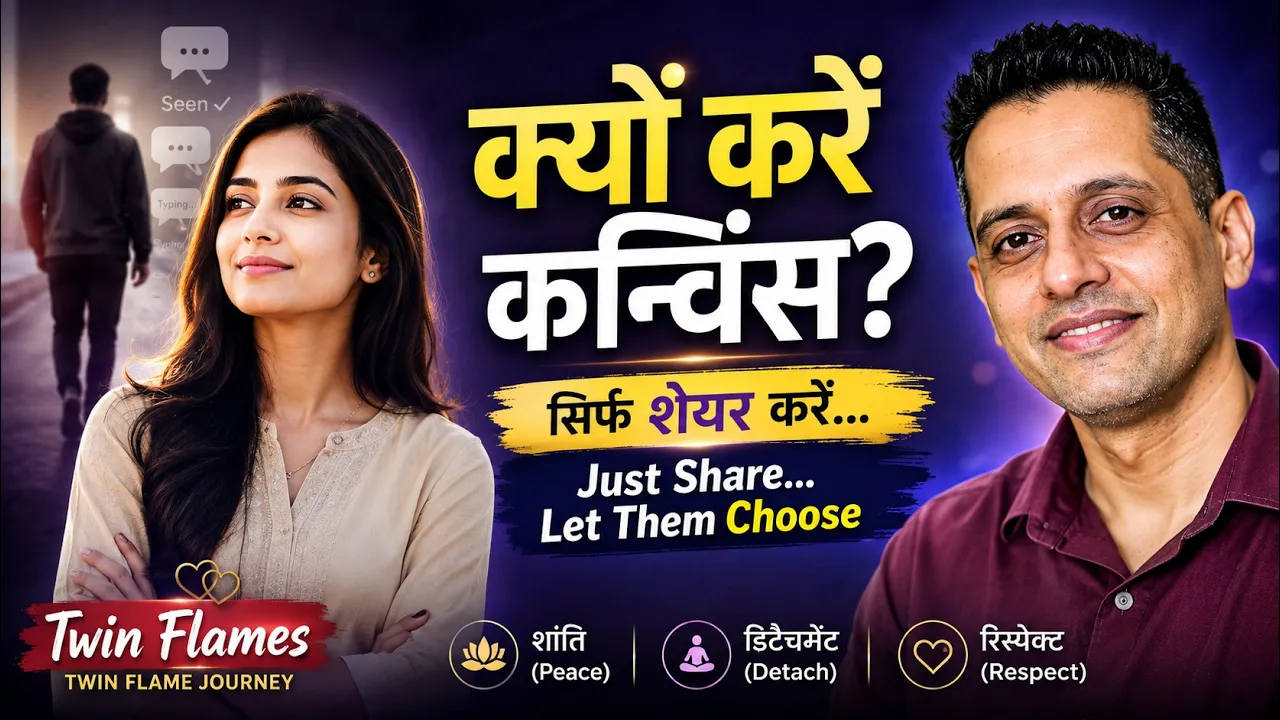
Convincing Twin Flame
Have you ever tried very hard to convince someone to do what you believed was best for them or Convincing Twin Flame?
Maybe you were:
- trying to help
- offering guidance
- sharing your experience
- protecting them from making a mistake
Your intention was good.
But later, things did not go as expected.
Instead of appreciation, you experienced:
- frustration
- blame
- disappointment
- emotional exhaustion
And eventually, a question appeared:
“Why did I try so hard to convince them in the first place?”
The Hidden Difference Between Sharing and Convincing
Many people use these two approaches interchangeably, but they are very different.
Sharing means:
- offering information
- expressing your perspective
- describing your experience
- allowing the other person to decide
Convincing means:
- pushing toward a particular decision
- influencing someone’s choice
- trying to make a specific outcome happen
The moment we move from sharing into convincing, we often start becoming emotionally attached to the outcome.
And that attachment creates problems.
Why Convincing Twin Flame Creates Emotional Responsibility
When you convince someone to take a particular action or when you try Convincing Twin Flame, something subtle happens.
You begin feeling connected not only to their decision but also to its result.
If things go well, everything feels fine.
But if things go wrong, you may start feeling:
- responsible
- guilty
- defensive
- emotionally burdened
The other person may also unconsciously connect you to the outcome.
This is why convincing often creates emotional weight that was never yours to carry.
How Convincing Twin Flame Often Leads to Blame
Human beings naturally look for explanations when things do not work out.
And sometimes, they look for someone to blame.
Imagine situations like:
- investment advice
- career decisions
- business recommendations
- relationship guidance
- education choices
If the outcome is disappointing, people may think:
- “I followed your advice.”
- “You told me to do this.”
- “I would not have done it otherwise.”
Even when your intention was positive, the blame often returns to the person who pushed hardest for the decision.
Why Good Intentions Are Not Enough
Many people become confused here.
They think:
“But I was only trying to help.”
And that may be completely true.
The problem is not the intention.
The problem is becoming attached to how another person’s life should unfold.
The outcomes depend on many factors:
- timing
- readiness
- circumstances
- personal growth
- future choices
No one can fully control those factors.
What Happens When People Are Not Ready
One of the most important insights from the discussion is that people may not be ready for a decision yet.
Perhaps they need:
- more experience
- more clarity
- more mistakes
- more learning
When we convince someone too early, we may accidentally interfere with their natural decision-making process.
As a result:
- they do not fully own the decision
- they may not understand the consequences
- they may later regret following the advice
And everyone becomes frustrated.
Why Convincing Your Twin Flame Creates Frustration
This pattern becomes especially common on the twin flame journey.
Many people try to convince their twin flame that:
- the connection is special
- the relationship has a spiritual purpose
- they should heal
- they should change their lifestyle
- they should see things differently
The intention often comes from love.
But if the other person is not ready, they may:
- ignore the information
- reject it
- avoid the conversation
- become defensive
Meanwhile, the person doing the convincing becomes emotionally exhausted.
Every Person Has Their Own Journey
A powerful theme is personal responsibility.
Every individual has:
- their own lessons
- their own timing
- their own experiences
- their own growth process
Sometimes people need to learn through direct experience rather than advice.
As difficult as it may feel, growth cannot always be transferred through explanation alone.
The Problem With Taking Responsibility for Someone Else
When you constantly try to convince others, you may unknowingly start carrying responsibilities that do not belong to you.
This creates:
- stress
- guilt
- emotional burden
- unnecessary involvement
Most people already have enough responsibilities in their own lives.
Taking responsibility for another adult’s decisions often creates more suffering than support.
A Better Approach: Share, Then Let Go
Instead of convincing, the discussion recommends sharing.
You can share:
- your experience
- your observations
- your understanding
- what worked for you
Then allow the other person to process it in their own way.
This creates space for:
- personal choice
- personal responsibility
- authentic learning
And it frees you from carrying unnecessary emotional weight.
When Guidance Is Appropriate
Young children depend on parents and guardians for guidance and decision-making.
In those situations:
- direction may be necessary
- responsibility remains with the parent
However, when dealing with independent adults, the dynamic changes.
Adults ultimately become responsible for:
- their choices
- their actions
- their outcomes
Are You Helping or Trying to Control?
Before giving advice, it may help to ask yourself:
- Am I sharing or convincing?
- Am I attached to a specific outcome?
- Am I comfortable if they choose a different path?
- Do I trust their ability to learn from their own experiences?
These questions often reveal whether support has quietly turned into control.
What Real Support Looks Like
Real support does not force decisions.
Real support:
- provides clarity
- shares wisdom
- offers tools
- respects freedom
Helping someone does not require controlling their choices.
In fact, respecting another person’s journey is often one of the deepest forms of support.
Why Life Coaching Uses a Different Approach
One interesting point discussed is the philosophy used in many life coaching methods.
Rather than telling people exactly what to do, coaches often:
- ask questions
- provide frameworks
- offer tools
- help people find their own answers
This creates ownership.
When people arrive at their own conclusions, they are generally more committed to the decisions they make.
Final Reflection
The next time you feel the urge to convince someone, pause and ask yourself:
“Am I offering guidance, or am I trying to control the outcome?”
Because true support is not about making someone choose your path.
It is about sharing what you know, respecting their journey, and allowing them the freedom to learn through their own experiences 🌿

FAQs
Why does convincing people or Convincing Twin Flame often backfire?
Because convincing creates emotional attachment to the outcome and may interfere with another person’s natural decision-making process.
Is it okay to give advice to others?
Yes. The discussion encourages sharing information and experiences. The concern is becoming attached to making someone follow a specific decision.
Why does convincing a twin flame create frustration?
If your twin flame is not ready for the information, they may resist or ignore it, leading to disappointment and emotional exhaustion.
What is the difference between sharing and convincing?
Sharing provides information and allows choice. Convincing pushes toward a particular outcome or decision.
How can I support someone without controlling them?
Share your experience, offer clarity, and allow them to make their own decisions and learn from their own journey.

Jnana Param is a Spiritual Teacher, Twin Flames Coach and Kundalini Yoga practitioner. About Jnana Param